

 Русский
 Turkish
 Português (Brasil)
 한국어
한국어 العربية
 Español
 ไทย
ไทย Tiếng Việt
 Français
 中文
中文 Deutsch
 Bahasa Indonesia
 Italiano
 日本語
日本語 Polski
 Українська
 فارسی
فارسی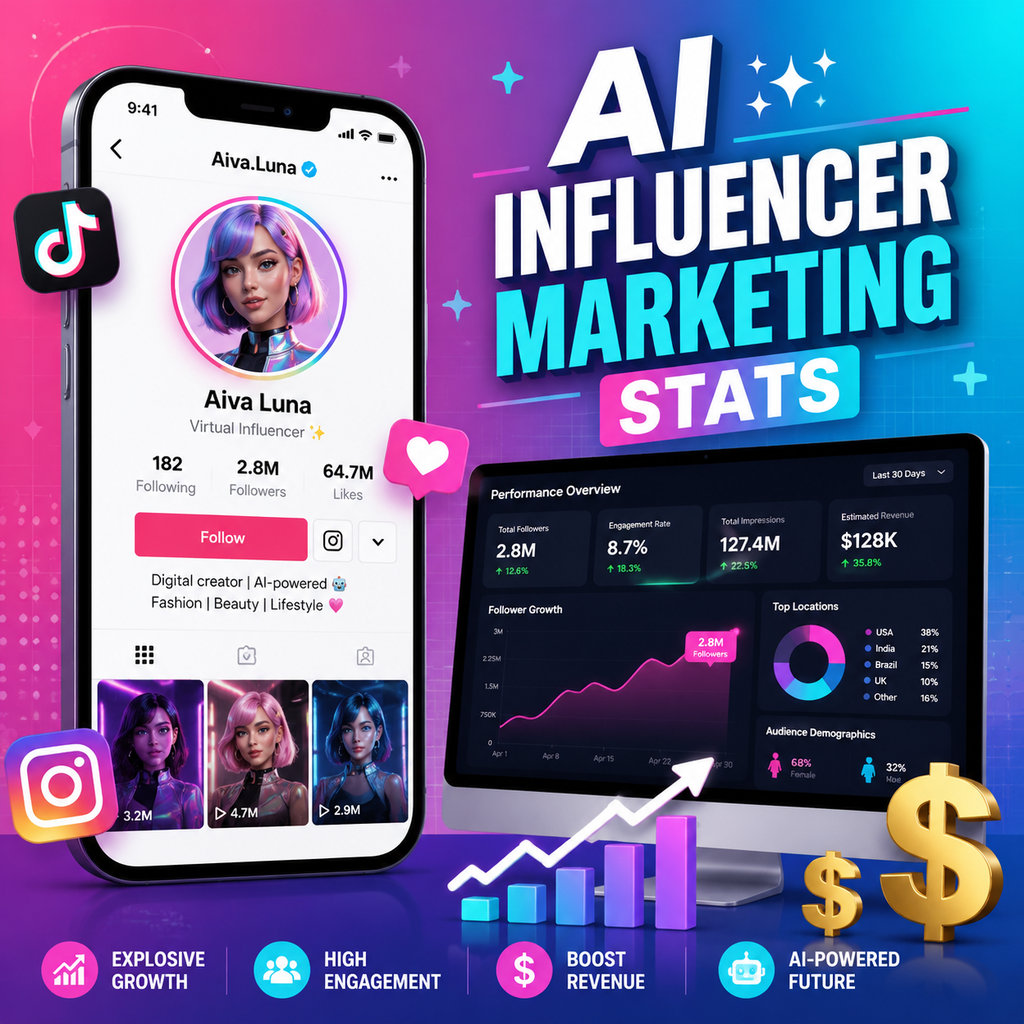
The Virtual Influencer Market Explodes Past $11 Billion
The global virtual influencer market reached $11.74 billion in 2026, far surpassing earlier projections. This rapid growth shows no signs of slowing, with forecasts placing the market at $154.6 billion by 2032, representing a compound annual growth rate (CAGR) of 41.29%. For context, the broader influencer marketing economy—including human creators—hit $32.55 billion in global spend during 2025. Virtual influencers now command a significant and growing share of that total, signaling a fundamental shift in how brands approach digital influence.
China alone accounted for $1.6 billion in virtual influencer spend, fueled by 340 million active virtual influencer followers. Brands in beauty and personal care lead adoption at 89%, while overall brand adoption climbed from 60% to 73% of surveyed companies in 2026. Chief Marketing Officers are now allocating up to 30% of their influencer marketing budgets to virtual personas, with brands above the 25% allocation threshold reporting 41% higher ROI.
Engagement Rates: Virtual Influencers Outperform Humans 3x
One of the most compelling statistics is engagement. Virtual influencer campaigns average a 5.67% engagement rate versus 1.89% for human creators—roughly three times higher, according to HypeAuditor. This gap persists across platforms, with AI-generated personas consistently driving more interactions per post. The reasons are multifaceted: virtual influencers can post consistently without fatigue, maintain perfect brand alignment, and tap into audience curiosity about the technology itself.
Consumer Adoption and Purchasing Behavior
Consumer skepticism is fading. Approximately 58% of US consumers now follow at least one virtual influencer, and 35% of Gen Z report buying products promoted by an AI persona. Globally, 52% of social media users follow a virtual influencer, with nearly half (49.3%) viewing them positively. This growing acceptance translates directly into purchasing power, making virtual influencers a viable channel for driving sales rather than just awareness.
Revenue and ROI: The Bottom Line
Virtual influencers don't just engage—they convert. They typically cost about 30% less than human creators while delivering better returns. Lu do Magalu earned an estimated $2.5 million in 2024 across 74 brand collaborations—roughly $34,320 per post and 40 times the average human creator's annual income. Lil Miquela has generated approximately $11 million in career brand-deal revenue across partnerships with Prada, Calvin Klein, and Samsung. These figures demonstrate that virtual influencers can command premium rates and deliver measurable business impact.
Average enterprise spend on virtual influencer development reached $1.4 million per brand in 2025, a 94% increase over the $720,000 average recorded in 2023. This investment is justified by performance: 71% of brands believe AI influencers can provide higher ROI compared to human influencers, and 66.4% of marketers report improved campaign outcomes after implementing AI tools, including 37% higher engagement and 37% more efficient targeting.
AI Adoption Surges Among Marketers
AI has reached critical mass in influencer marketing. As of 2026, 60.2% of marketers actively use AI for influencer identification and campaign optimization, while 75% of professional creators use AI tools for content planning, scriptwriting, and video editing. These tools help creators produce 40% more content than they did two years ago. Additionally, 89.44% of marketing teams have integrated AI tools into at least one part of their influencer workflow, and 92% of brands are either actively using or open to implementing AI to support their influencer marketing workflows.
The benefits are clear: time savings in campaign management, streamlined content creation, and improved performance tracking. However, challenges remain. Budget constraints, limited technical expertise, and organizational resistance to change are common hurdles. Roughly 60% of marketers initially expressed concern about AI jeopardizing their roles, but as results come in, those fears are giving way to adoption.
Fraud, Regulation, and Ethical Considerations
The rapid growth of AI in influencer marketing has a dark side. An estimated $4.8 billion was lost to influencer fraud in 2026, with AI-synthetic fraud accounting for $2.1 billion. Deepfake-enabled influencer fraud caused an estimated $23.7 billion in global losses, with 74% of deepfake scam content generated using AI tools costing under $50 per campaign. In response, the FTC's final rule banning fake and AI-generated consumer reviews took effect on October 21, 2024, and 2,340 creators are under investigation for fake or AI-generated reviews.
While 80% of advertisers are positive toward AI, only 48% of consumers share that view. Consumer concerns include bias in GenAI models, the creation of false testimonials, and deepfakes. Brands must navigate these concerns carefully, balancing automation with authenticity and transparency to maintain trust.
The Future of AI Influencer Marketing
The trajectory is clear: AI and virtual influencers are not a passing trend but a permanent evolution of the marketing landscape. With a CAGR exceeding 40%, the virtual influencer market will continue to outpace traditional influencer growth. CMOs allocating up to 30% of budgets to virtual personas, 89% adoption in beauty and personal care, and 35% of Gen Z already purchasing from AI influencers are signals that this channel is becoming mainstream. The key for brands is to embrace the efficiency and engagement of AI while remaining vigilant about authenticity and regulation—ensuring that as the technology evolves, so does the trust that underpins influencer marketing success.