

 English
 Русский
 Turkish
 Português (Brasil)
 한국어
한국어 العربية
 Español
 ไทย
ไทย Français
 中文
中文 Deutsch
 Bahasa Indonesia
 Italiano
 日本語
日本語 Polski
 Українська
 فارسی
فارسی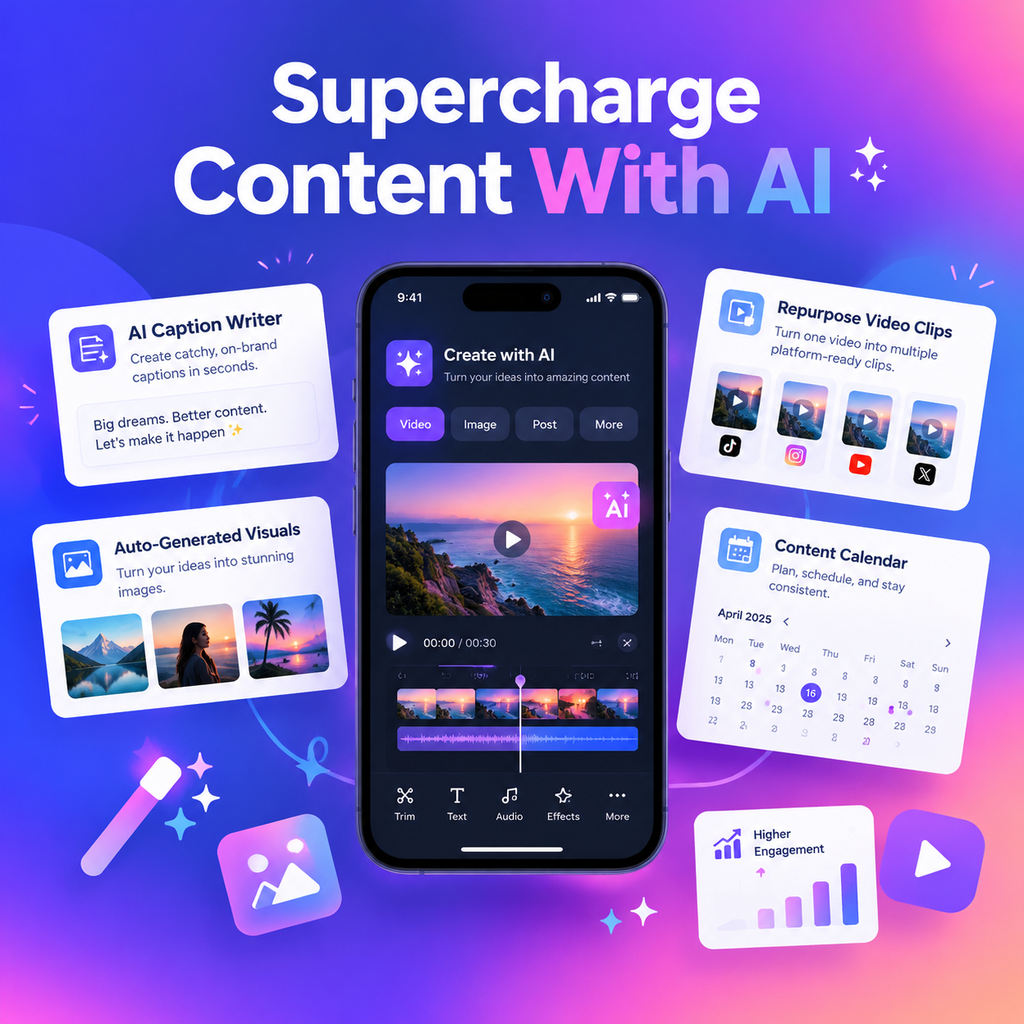
Start with the bottleneck, not the tool
Every creator hits a wall somewhere in their workflow. For some, it's staring at a blank caption box at 11 p.m. For others, it's editing a 40-minute podcast into six Reels before lunch. The temptation is to sign up for every shiny AI platform that promises to "revolutionize" your content. But the smarter move is to diagnose your actual bottleneck first. Are you slow at writing hooks? Do your visuals look inconsistent? Does scheduling eat two hours every Monday? Once you name the pain point, picking the right tool becomes obvious. This article walks you through using AI across writing, visuals, video, and scheduling — so you can move faster without sacrificing the human touch that makes your brand worth following.
Writing captions and hooks with AI
Captions and hooks are where most creators lose momentum. AI writing assistants like Jasper, Anyword, and Claude can pull you out of the blank-page spiral fast. The key is feeding them context: your brand voice, past top-performing posts, and the specific platform you're writing for. Jasper, for example, lets you train a brand voice by uploading your existing content, so its output sounds like you — not like a generic marketing bot. Anyword goes a step further by scoring copy variations based on predicted engagement, which is useful when you're testing hooks. Claude, meanwhile, shines as a flexible assistant that can hold your brand guidelines in a project workspace and churn out on-brand captions across formats.
Prompting for platform-native copy
Don't ask AI for "a caption." Ask for a LinkedIn post that opens with a contrarian take, or a TikTok hook under 12 words, or a carousel caption with a question at the end. Platform-native prompts produce platform-native results.
Designing scroll-stopping visuals without a designer
Visual consistency separates professional accounts from amateur ones, but hiring a designer isn't realistic for most creators. Canva's Magic Studio handles the heavy lifting with Magic Layers, which turns AI-generated images into editable components — so you can move elements, fix text, and resize for different formats without starting over. Adobe Express with Firefly is the go-to if commercial safety matters; its text-to-image generation is trained on licensed content, which reduces copyright risk for brand work. And Ideogram is quietly brilliant for text-heavy graphics, because it renders readable text directly inside images — something most AI generators still fumble. Together, these tools cover carousels, story graphics, thumbnails, and quote posts at speed.
Turning long-form video into short-form gold
Video repurposing is where AI saves the most time. OpusClip's ClipAnything feature scans long videos and cuts the moments most likely to perform, using speech patterns and retention cues to rank clips. Riverside's Co-Creator takes a different angle: record a podcast or interview inside the platform, and the AI editing agent produces clips, thumbnails, and promotional assets from the same session. The result is a month of short-form content from a single recording day. Just budget time for human trimming — AI clip selection is good, not perfect, and a 10-second manual edit often doubles a clip's impact.
Match the clip to the platform
Vertical, captioned, and punchy for TikTok and Reels; slightly longer and more narrative for LinkedIn. AI tools auto-reframe for aspect ratios, but you still control the story arc.
Scheduling and publishing on autopilot
Creating content is half the battle; getting it out consistently is the other half. Tools like Buffer adapt copy for each channel automatically — its AI Assistant detects whether you're posting to LinkedIn or X and adjusts tone and length accordingly. Perch by Hootsuite combines AI creation with scheduling and publishing, plus a "Wisdom" agent that surfaces industry trends and drops drafts straight into your content calendar. SocialBee's Copilot builds a full strategy with content pillars and a posting plan, which is ideal if you're recycling evergreen content. The goal is a workflow where your calendar fills itself while you focus on the creative decisions only you can make.
Avoiding the AI content trap
AI can make you faster, but it can also make you sound like everyone else. The creators who win with these tools treat them as first-draft machines, not final-draft authors. Always inject personal anecdotes, opinions, and specifics that AI can't fabricate. Watch for accuracy issues in generated copy — a confident-sounding caption with a wrong stat is worse than no caption at all. And rotate your tools if output starts feeling formulaic; even the best AI models drift toward predictable phrasing when used too heavily. The sweet spot is AI for structure, speed, and variation, and your voice for the parts that build trust with your audience.
Building your AI-powered content stack
You don't need ten subscriptions. Pick one tool per job: a writing assistant, a visual platform, a video repurposer, and a scheduler. Test each for two weeks against a real content goal — more posts shipped, higher engagement, less time spent — and keep only what moves the needle. As AI features evolve through 2026, the creators who thrive won't be the ones with the most tools, but the ones with the tightest workflow. Start with your biggest bottleneck, add one AI layer, and measure the difference. That's how you supercharge your content without losing yourself in the process.