

 English
 Русский
 Turkish
 Português (Brasil)
 한국어
 العربية
 Español
 ไทย
 Tiếng Việt
 中文
 Deutsch
 Bahasa Indonesia
 Italiano
 日本語
 Polski
 Українська
 فارسی
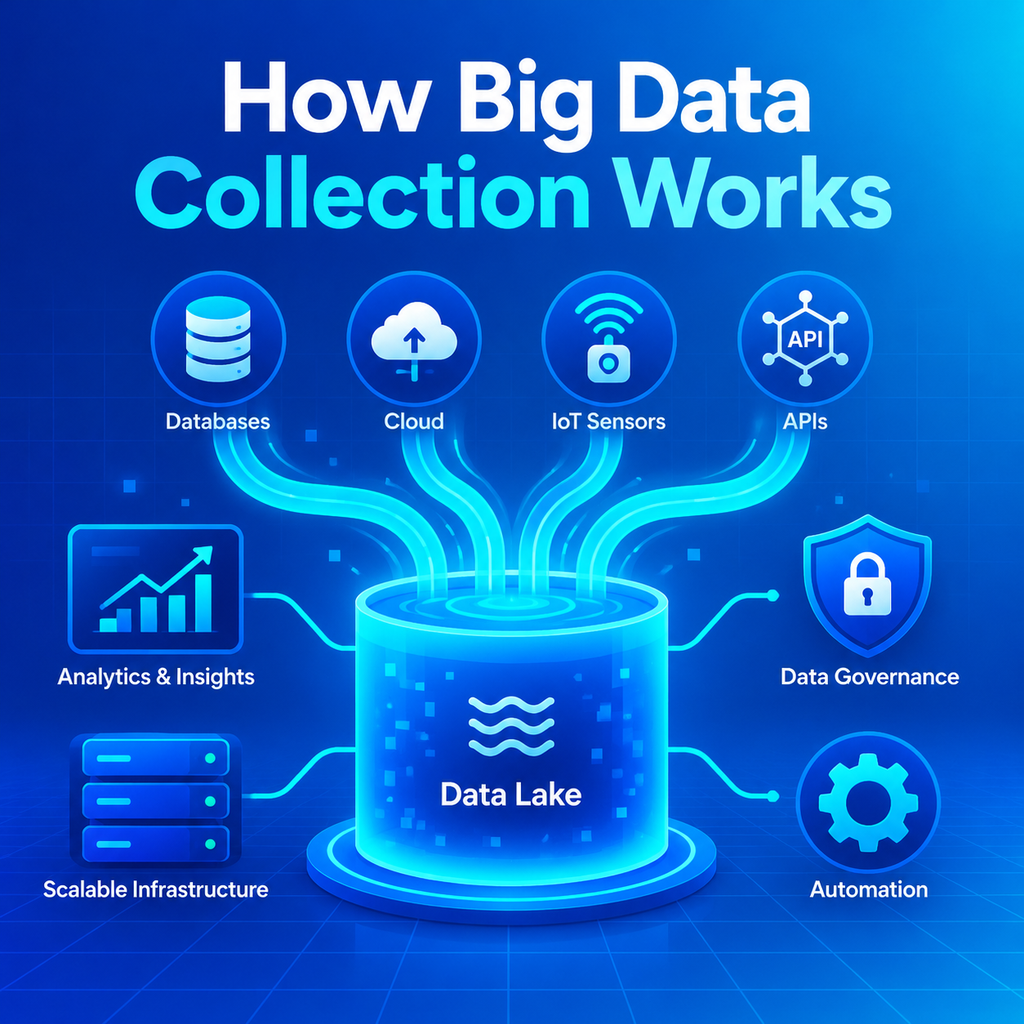
The Big Data Collection imperative
In the age of analytics, automation, and AI, big data collection is the backbone of informed decision-making. Yet, gathering data from myriad sources is not a simple task. It requires a strategic approach that balances business objectives, technical feasibility, and governance. Without a robust collection process, organizations risk drowning in a sea of irrelevant or poor-quality data, rendering their analytics efforts futile. This article explores the step-by-step process, common methods, and persistent challenges of big data collection, offering practical insights for data leaders.
Defining the data collection process
A systematic data collection process is essential for consistency and repeatability. It typically begins with aligning collection efforts with business goals, identifying relevant data sources, and designing the necessary infrastructure. Data teams must implement error-handling mechanisms, validate and cleanse data, catalog it for easy retrieval, and establish governance from the outset. As Goyal notes, "Data loses value in silos," so integrating data into a unified architecture—like a data lake or fabric—is critical. This ensures that data scientists and AI systems can access the right data without friction, turning raw data into a strategic asset.
Seven key steps
Experts recommend a structured sequence: define objectives, map sources, deploy infrastructure, implement collection with monitoring, cleanse and validate, catalog with metadata, and enforce governance. Each step builds on the previous, creating a repeatable pipeline that supports scalable analytics.
Common methods of collecting big data
The choice of collection method hinges on data type and source. Batch processing, often via ETL or ELT, remains popular for structured data, while ELT is favored for unstructured and semistructured data due to its flexibility. Real-time methods like APIs, streaming, and change data capture (CDC) capture event data as it happens, enabling immediate insights. IoT devices aggregate sensor data for centralized transmission, and external data is gathered through web scraping and third-party feeds. Each method has its place, and often a combination is needed to cover all bases.
Batch vs. Real-time
Batch collection is cost-effective for large volumes, but real-time streams are indispensable for time-sensitive applications like fraud detection or personalized marketing. Organizations should assess their latency requirements to choose the right mix.
Overcoming data collection challenges
Data collection is fraught with challenges, from ensuring data quality and consistency to navigating privacy regulations. With data coming from diverse sources, inconsistencies and duplicates are common, necessitating robust cleansing and validation. Security is another major concern; encryption and access controls must be baked into the collection process. Moreover, compliance with regulations like GDPR and CCPA requires careful planning. As Goyal emphasizes, "Data ownership, access controls and compliance requirements shouldn't be afterthoughts." By integrating governance early, organizations can mitigate risks and build trust.
Quality and consistency
Implementing validation rules, anomaly detection, and deduplication during collection helps maintain data integrity. Regular audits and automated monitoring can catch issues before they propagate downstream.
Best practices for effective big data collection
To stay agile, data leaders should treat collection as a dynamic process, continuously refining it as business needs evolve. Automation through AI and data management tools can streamline tasks, uncover ingestion failures, and track compliance. Thota recommends data minimization to reduce storage costs and risk, strong encryption for data at rest and in motion, comprehensive audit trails, and documentation of data lineage. Investing in training and staying abreast of regulatory changes are also vital. These practices not only improve efficiency but also fortify security and governance.
Leveraging AI and automation
AI-powered tools can automate data discovery, classification, and quality checks, freeing up teams to focus on higher-value tasks. They also provide real-time monitoring, ensuring that collection pipelines operate smoothly.
Integrating data for unified analytics
Collecting data is only half the battle; integrating it into a centralized repository or fabric is equally important. Silos hinder analytics and AI, as teams waste time hunting for data across systems. A data lake or lakehouse consolidates structured and unstructured data, while a data fabric connects disparate platforms through virtualization. This integration enables seamless access and collaboration, accelerating time-to-insight. As part of the collection process, data should be cataloged and tagged with metadata to facilitate discovery and usage.
Building a data fabric
A data fabric uses active metadata and machine learning to unify data across environments, providing a virtual layer that abstracts complexity. This approach is particularly useful for hybrid and multi-cloud setups.
Future-proofing your collection strategy
The landscape of big data is ever-evolving, with new sources and regulations emerging regularly. A future-proof collection strategy is flexible, scalable, and governed by strong policies. It embraces automation, prioritizes data quality, and fosters a culture of data stewardship. By following best practices and learning from challenges, organizations can turn data collection into a competitive advantage. Ultimately, the goal is to create a self-reinforcing data flywheel where collected data fuels insights, which in turn drive smarter collection—a virtuous cycle that powers innovation and growth.