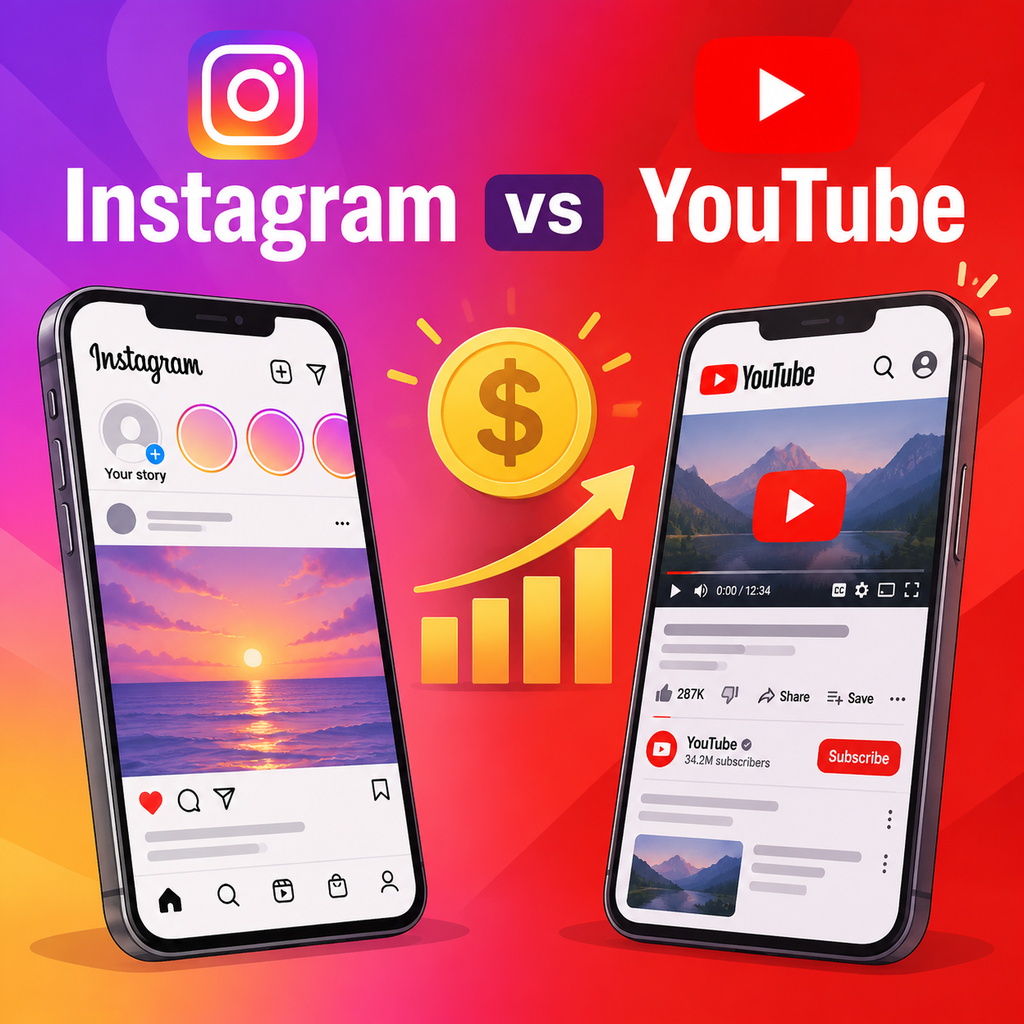
The fundamental earnings divide: per-view payouts vs. brand deals
When you compare creator earnings on Instagram and YouTube, you're not just comparing two platforms—you're comparing two completely different economic models. YouTube pays creators directly through ad revenue sharing, while Instagram relies almost entirely on brand sponsorships and off-platform deals. This structural difference shapes everything from income predictability to long-term growth potential.
On YouTube, once you join the Partner Program, you earn a share of ad revenue generated from your videos. That means every view has a tangible dollar value, and that value compounds over time as your library grows. Instagram, by contrast, doesn't pay per view. Its native monetization tools—like Reels bonuses and subscriptions—are invite-only, seasonal, or limited in scope. Most Instagram creators earn through brand deals negotiated outside the platform, which are lucrative but irregular.
Understanding this divide is crucial for any creator planning their income strategy. Let's break down the numbers and see where each platform truly shines.


YouTube's direct payouts: a reliable baseline
YouTube's Partner Program (YPP) is the gold standard for direct creator monetization. Creators earn approximately 55% of ad revenue on long-form videos, which translates to a Revenue Per Mille (RPM) ranging from $2 to $12 per 1,000 views in 2026. In high-value niches like finance and tech, RPMs can soar to $20 or more. For a creator with 100,000 subscribers in a mid-tier niche, that means $1,500 to $5,000 per month from ads alone—a predictable baseline that brands deals can supplement.
But YouTube's monetization doesn't stop at ads. Channel memberships, Super Chat, Super Thanks, and YouTube Shopping create multiple revenue streams that stack on top of ad income. This diversified approach reduces dependency on any single source, making earnings more resilient. Even YouTube Shorts, which pay significantly less per view ($0.02 to $0.13 per 1,000 views), contribute to the ecosystem by funneling viewers toward longer, more monetizable content.
Instagram's brand deal economy: high value, low frequency
Instagram remains the undisputed king of brand partnerships. With 66.71% of all creator payment volume flowing through the platform, it's where the most deals happen. However, the average payment per deal is $1,429—significantly lower than YouTube's $2,228 per payment (which includes ad revenue and other direct payouts). This discrepancy highlights Instagram's core strength and weakness: it's a volume game with high variability.
Nano-influencers (1,000–10,000 followers) can charge $25 to $150 per sponsored post, while mid-tier creators with 100,000 followers command $1,000 to $5,000 per post. Top-tier influencers with millions of followers can earn $10,000 or more per deal. Yet these earnings are bursty—a great month might bring in five figures, but a dry spell means zero income. Instagram's direct payouts, like Reels bonuses, are minimal and inconsistent, often paying as little as $0.01 to $0.12 per 1,000 plays when they're active at all.
Comparing average monthly earnings: YouTube vs. Instagram
Data from a 2026 survey of 1,000 creators reveals a stark contrast in average monthly earnings. YouTube creators earn an average of $3,450 per month, with a median of $1,250. Instagram creators, on the other hand, average $2,100 per month, with a median of just $850. The top 10% of YouTube creators earn $12,500 or more monthly, while the top 10% on Instagram earn $9,500 or more.
These figures underscore a critical point: YouTube offers higher earning potential and a more stable income floor. Instagram's average is skewed by a small number of high-earning brand-deal specialists, but the median tells a different story—most Instagram creators earn less than their YouTube counterparts. For creators prioritizing financial stability, YouTube's predictable ad revenue provides a solid foundation that Instagram simply cannot match.
Follower count vs. engagement: what really drives income
It's tempting to assume that more followers automatically means more money, but the data tells a more nuanced story. Engagement rate—measured by comments, shares, and saves—is three times more predictive of earnings than follower count alone. On YouTube, watch time and audience retention directly influence ad revenue, rewarding creators who build deep connections with their viewers. On Instagram, high engagement signals to brands that a creator's audience is active and responsive, which can justify higher rates for sponsored posts.
Interestingly, the follower ranges where each platform shines differ. YouTube creators with 10,000 to 50,000 subscribers can earn $300 to $1,500 monthly from ads, while Instagram creators in the same range earn $500 to $2,000 from brand deals. At the 100,000-follower mark, YouTube earnings jump to $3,000–$10,000, while Instagram earnings reach $4,000–$12,000. But beyond 500,000 followers, YouTube's ceiling rises dramatically, with top creators earning $25,000 to $100,000+ per month, compared to Instagram's $12,000 to $30,000.
The hybrid advantage: using both platforms strategically
Many successful creators don't choose between Instagram and YouTube—they use both. Instagram excels at discovery, quick engagement, and landing brand deals, while YouTube provides long-term, evergreen income and deeper audience relationships. A common strategy is to use Instagram to build a following and attract sponsors, then funnel that audience to YouTube for more immersive content and higher per-view earnings.
For example, a creator might post short-form Reels on Instagram to showcase their personality and drive traffic to their YouTube channel, where they publish in-depth tutorials or vlogs. The YouTube videos generate ad revenue for years, while the Instagram posts bring in immediate brand deal opportunities. This hybrid approach leverages the strengths of each platform: Instagram's speed and brand appeal, and YouTube's stability and scalability. According to earnings reports, creators who effectively cross-promote tend to outperform single-platform creators by 30–50%.
Longevity and evergreen income: YouTube's compounding advantage
Perhaps the most significant difference between the two platforms is the lifespan of content. A YouTube video published in 2023 can still earn $100+ per month in 2026 if it ranks for evergreen search terms. This compounding effect means that a creator's back catalog becomes a growing asset, generating passive income long after publication. Instagram posts, by contrast, have a much shorter shelf life—90% of engagement occurs within the first seven days, and there's no equivalent to AdSense to keep earning from old content.
This evergreen nature of YouTube makes it particularly attractive for creators who want to build long-term wealth. While Instagram offers faster initial returns and higher per-deal rates, it requires constant content creation to maintain visibility and income. The mental model is simple: Instagram pays faster, YouTube pays forever. For creators planning a career that spans decades, YouTube's compounding ad revenue is hard to beat.
Which platform should you choose? It depends on your goals
So, where do creators earn more? The answer depends on your priorities. If you value predictable, steady income and the potential for long-term growth, YouTube is the clear winner. Its direct ad revenue, memberships, and evergreen content create a financial foundation that Instagram can't replicate. If you're skilled at landing high-value brand deals and thrive in a fast-paced, trend-driven environment, Instagram can deliver impressive paydays—but you'll need to hustle constantly to keep the pipeline full.
For most creators, the smartest approach is to use both platforms in tandem. Start with Instagram to build an audience and attract sponsors, then transition to YouTube to monetize that audience through ads and memberships. By diversifying your income streams and leveraging each platform's unique strengths, you can maximize your earnings while minimizing risk. In the end, the real winner isn't Instagram or YouTube—it's the creator who knows how to make both work for them.
 Русский
 Turkish
 Português (Brasil)
 한국어
 العربية
 Español
 ไทย
 Tiếng Việt
 Français
 中文
 Deutsch
 Bahasa Indonesia
 Italiano
 日本語
 Polski
 Українська
 فارسی


