

 Русский
 Turkish
 Português (Brasil)
 한국어
한국어 العربية
 Español
 ไทย
ไทย Tiếng Việt
 Français
 中文
中文 Deutsch
 Bahasa Indonesia
 Italiano
 日本語
日本語 Polski
 Українська
 فارسی
فارسی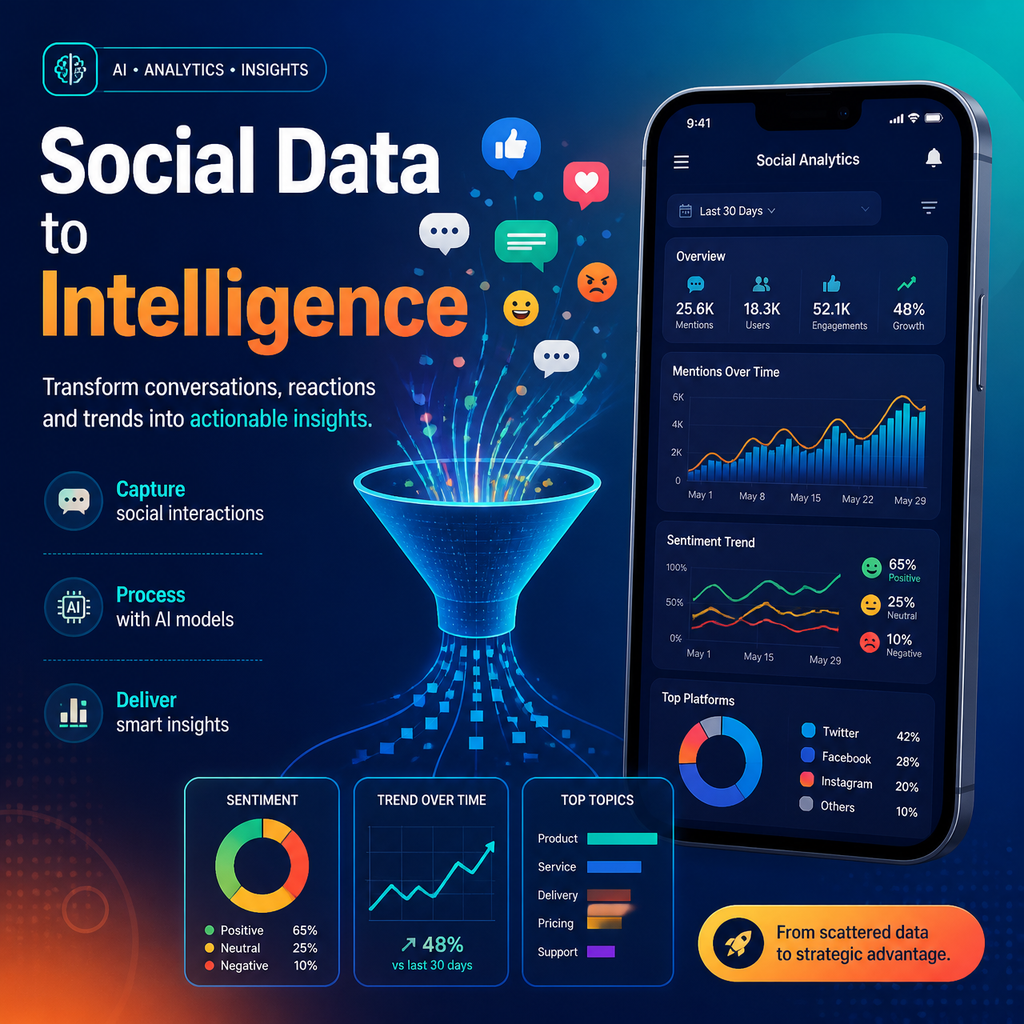
The Social Media Data Deluge
Every day, billions of posts, comments, and shares flood social platforms, creating a vast ocean of unstructured data. For businesses, this is both a goldmine and a challenge. The raw text, images, and videos hold invaluable insights into consumer behavior, preferences, and sentiment, but extracting meaningful intelligence from this chaotic mix requires a sophisticated approach. Traditional analytics often fall short, leaving organizations overwhelmed by the sheer volume and complexity of social data. The key lies in transforming this unstructured information into structured, actionable insights that drive strategic decisions.
Social media analytics has evolved from simple metrics like likes and shares to a nuanced discipline that combines technology, data science, and human judgment. It's no longer just about counting mentions; it's about understanding the context, emotion, and underlying trends that shape consumer narratives. This article explores how businesses can navigate the journey from raw data to intelligence, leveraging social listening, AI-driven analytics, and human expertise to gain a competitive edge.
Understanding Social Intelligence
Social intelligence, often referred to as social listening, is the process of collecting, monitoring, and analyzing social media data to understand what is being said about a brand, topic, or industry. It goes beyond surface-level metrics to uncover the 'why' behind consumer conversations. By tapping into organic, unsolicited opinions, businesses can gain a genuine understanding of their audience's needs, pain points, and aspirations.
This approach allows companies to move from a reactive to a proactive stance. Instead of waiting for surveys or sales data, they can detect emerging issues, identify opportunities, and track brand sentiment in real-time. Social intelligence provides a direct line to the consumer voice, making it an essential tool for modern market research.
The Three Building Blocks of Social Media Analytics
To build a robust social media intelligence program, organizations must integrate three key components: platforms, AI-driven analytics, and human insight. Each plays a crucial role in transforming raw data into actionable strategies.
Social Media Intelligence Platforms
These software solutions are the foundation of any social listening effort. They aggregate data from various sources, including social networks, blogs, forums, and review sites, providing real-time access to metrics through interactive dashboards. Platforms like Synthesio, a leader in the field, offer comprehensive data collection and visualization, enabling businesses to monitor conversations across 195 countries and 80 languages. Such platforms are essential for capturing the breadth of social data.
AI-Led Advanced Analytics
The unstructured nature of social media data—text, images, and videos—requires sophisticated AI to make sense of it. Natural Language Processing (NLP), machine learning, and statistical analysis are deployed to identify themes, sentiments, and trends. These technologies can categorize millions of mentions, detect emotional nuances, and even predict future behaviors. AI scales the analysis, making it possible to process vast datasets with speed and accuracy, turning noise into signal.
Human-Driven Insight Discovery
While AI is powerful, human expertise is irreplaceable in interpreting the intricate context and cultural subtleties of social conversations. Skilled analysts apply frameworks to validate AI findings, uncover 'unknown unknowns,' and translate data into strategic recommendations. This human touch ensures that insights are not just accurate but also relevant and actionable. The synergy between AI and human intelligence is what elevates social media analytics to true intelligence.
The Journey from Data to Intelligence
The transformation from unstructured data to intelligence follows a structured path. It begins with defining clear business questions—what you need to know and why. Next, data is collected from relevant sources, then cleaned and structured using AI tools. The analysis phase applies both top-down and bottom-up approaches: top-down tests hypotheses with proven frameworks, while bottom-up explores the data to discover emerging patterns. Finally, the insights are synthesized into compelling narratives that drive decision-making.
For example, during the COVID-19 pandemic, social intelligence was used to track changing consumer behaviors and concerns. By analyzing conversations, companies could pivot their strategies to address new needs, such as increased focus on health and safety. This real-time adaptability illustrates the power of turning data into actionable intelligence.
Overcoming Challenges and Embracing Opportunities
Social media analytics is not without its challenges. Data quality, privacy concerns, and the sheer volume of information can be daunting. However, with the right approach, these obstacles can be overcome. Advanced AI models can filter spam and irrelevant content, while ethical guidelines ensure responsible use of data. Moreover, integrating social data with other sources like surveys and search trends provides a more holistic view.
The opportunities are immense. Businesses can identify unmet consumer needs, track brand health, optimize marketing campaigns, and even predict future trends. By leveraging social intelligence, companies gain a strategic advantage, staying ahead of the curve in a rapidly evolving digital landscape.
The Future of Social Intelligence
As AI and machine learning continue to advance, the potential for social intelligence grows exponentially. We're moving towards predictive analytics, where insights not only describe what's happening but also forecast what's next. The integration of behavioral and attitudinal data will enable even deeper personalization and engagement. The key to success lies in embracing a hybrid approach that combines cutting-edge technology with human ingenuity.
Ultimately, the goal is not just to collect data but to derive intelligence that informs every business decision. By understanding the consumer voice in real-time, organizations can build stronger brands, create better products, and forge more meaningful connections. In a world driven by digital conversation, social media analytics is the compass that points the way forward.